

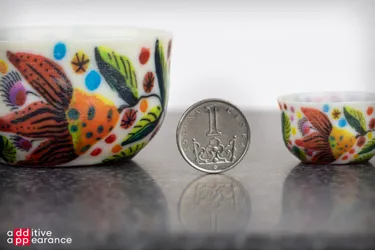
Together with CUIP and the Faculty of Mathematics and Physics at Charles University, we announce our company's founding.
15 Dec 2025

Tomáš Iser

Tobias Rittig

Alexander Wilkie
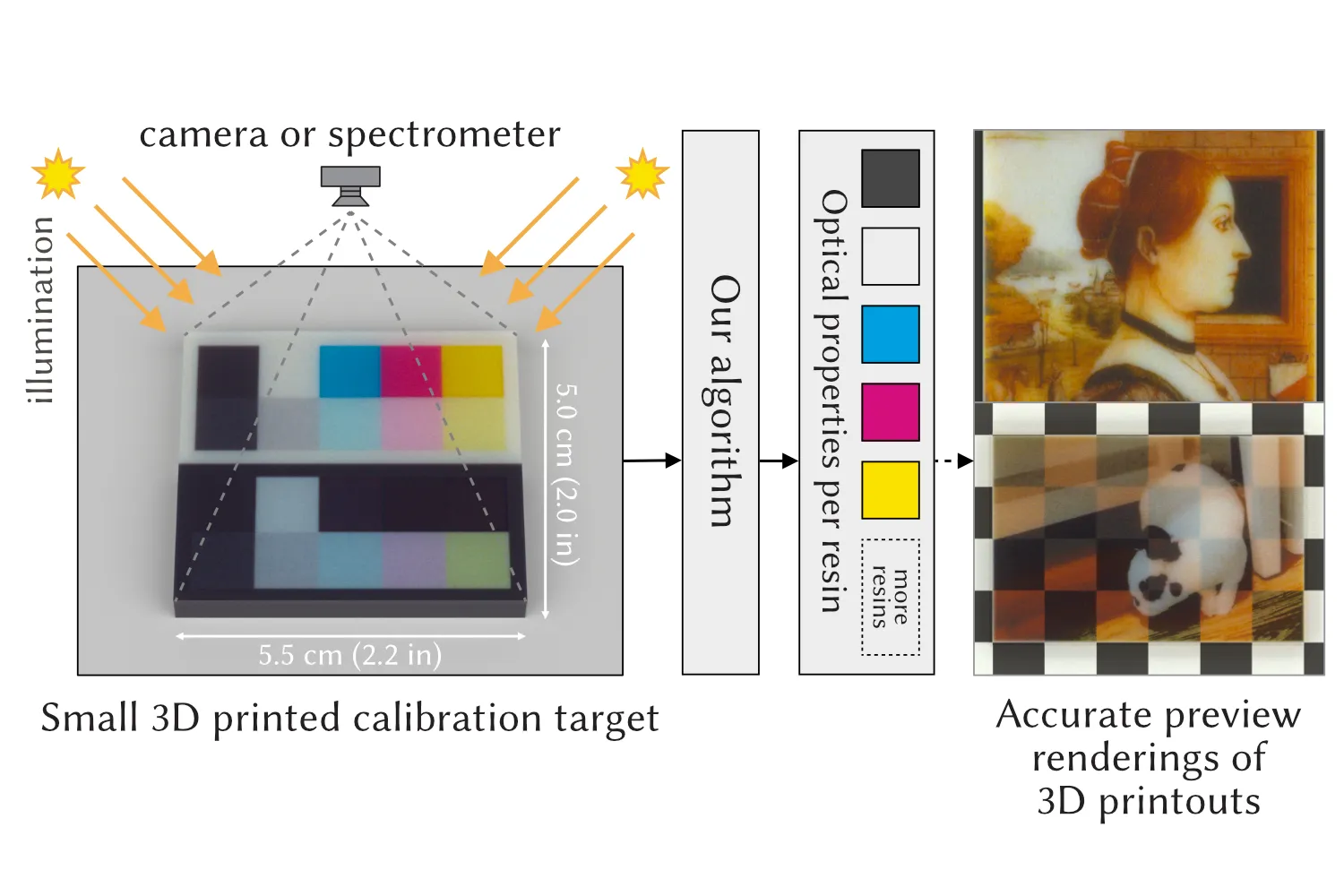
Our most recent research article was presented at SIGGRAPH Asia 2025 in Hong Kong and is published in the ACM Transactions on Graphics (TOG) journal. Receiving an Honorable Mention at the conference’s Technical Papers Awards places our work among the top-rated research contributions of the conference — a testament to its impact on the graphics and 3D printing community. Putting it into numbers: Of the 1106 submissions to the conference, only 101 were acceped for journal publication, with 200 conference-only papers receiving a presentation slot but won’t be published in the journal. Out of these 301 articles, ours and 9 others were honored at the awards ceremony.
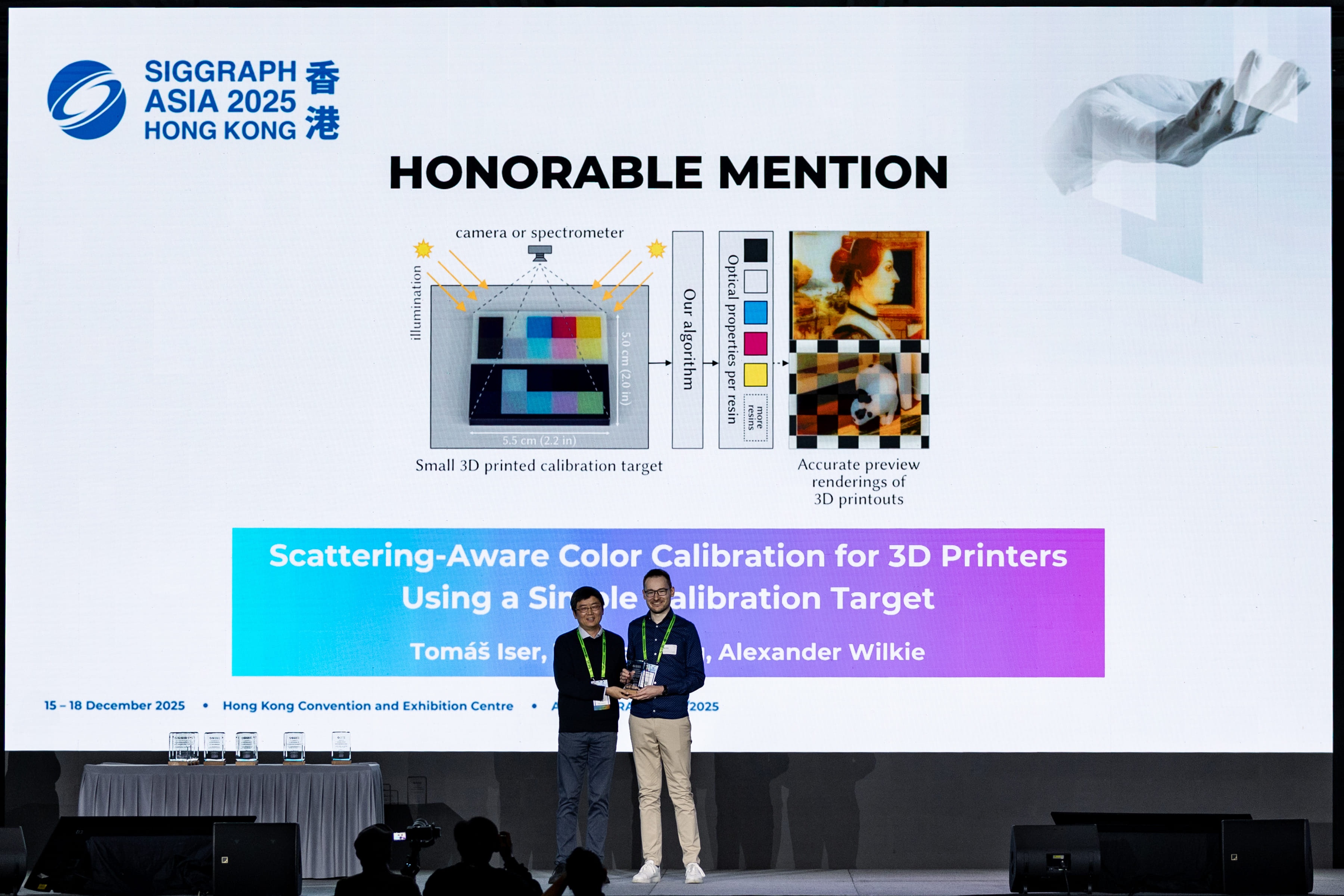
The article tackles the challenge of accurately calibrating colors on resin-based 3D printers but with minimal effort and manual intervention. Traditionally, tens of calibration charts had to be printed, manually polished and measured spot-by-spot. Each chart would be made up of hundreds of random ink combinations to explore their color-interaction. This method is inefficient and laboreous since it has to be repeated, whenever a single ink changes.
Our approach has been for years, to only calibrate each ink individually, and calculate the colors of their combinations using an accurate physical model. Hence, we are not measuring only surface color but physical properties of the material that are the parameters of the simulation. This is already our third research article on the topic, how to aquire these parameters with the least effort while maintaining the accuracy of expensive physics laboratory equipment.
In plain English: we created a printable calibration target that, when captured with a single photograph, lets us know how light behaves inside the resin, resulting in more faithful color reproduction. The method is particularly practical, since no manual processing (such as polishing or handling) is required on the target, nor does it require any specialized measurement equipment. Using just a single photograph, that can be taken (automatically) inside the printer, right after printing, we have enough information for our novel calibration algorithm to infer the translucency and light scattering behaviour of all printed resins at once.
Alternatively to the photograph, a spectrometer can also take point measurements of the individual squares (automatized) for increased color accuracy. A smart bootstrapping procedure then recovers the volumetric optical properties (including absorption, scattering and translucency) of the materials in minutes.
The article is Open Access meaning everybody can read it for free on the publishers website, ACM Digital Library. The text and images are also licensed under a Creative Commons licence (CC BY-NC 4.0), meaning anybody can re-use and modify it for non-commercial purposes, as long as they quote the original source. This is especially important for academic teachers and researchers down the line.
We expect this publication to pave the way towards self-calibrating printers that …
Especially that last point, about letting users combine arbitrary materials inside their printer and calibrate themselves, is something that was technically not feasible before. With our method, the user can swap out single resins, even from different manufacturers, quickly re-calibrate that single resin, and continue printing with confidence that the slicer software will be able to produce accurate colors on the printer.
Choosing to re-calbrate all materials at once is not much more expensive in terms of material or time. Hence, it becomes feasible for the printer to react to quality variations in the resins (in terms of color) that can occur from batch to batch during manufacturing or dyes changing over time (increasing the shelf-life).
The advantage of this approach comes into play, the more print-heads and material slots the printer has, where combinatorics make it intractable to measure the colors in the traditional way.
It is imaginable for this procedure to have an impact also in other fields where color systems are of great importance. Examples such as the Dental industry, industrial coatings and paints (e.g. in Automotive) or 2D printing come to mind.
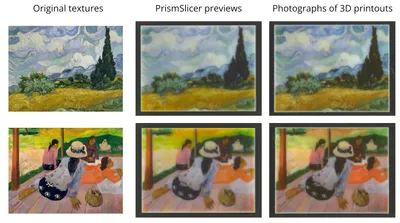
For now, we’re thrilled to see this research contribute to the broader graphics and additive-manufacturing communities. It strengthens the position of PrismSlicer, with its disruptive approach to color that allows for photorealistic previews and near-optimal priting results for a given hardware and materials. If you’d like to learn more, discuss potential collaborations, or explore how our technology can enhance your printer, please get in touch!
@article{iser_2025_scattering,
    author = {Iser, Tom\'{a}\v{s} and Rittig, Tobias and Wilkie, Alexander},
    title = {Scattering-Aware Color Calibration for 3D Printers Using a Simple Calibration Target},
    year = {2025},
    issue_date = {December 2025},
    publisher = {Association for Computing Machinery},
    address = {New York, NY, USA},
    volume = {44},
    number = {6},
    issn = {0730-0301},
    url = {https://doi.org/10.1145/3763293},
    doi = {10.1145/3763293},
    abstract = {We present a novel method for accurately calibrating the optical properties of full-color 3D printers using only a single, directly printable calibration target. Our approach is based on accurate multiple-scattering light transport and estimates the single-scattering albedo and extinction coefficient for each resin. These parameters are essential for both soft-proof rendering of 3D printouts and for advanced, scattering-aware 3D halftoning algorithms. In contrast to previous methods that rely on thin, precisely fabricated resin samples and labor-intensive manual processing, our technique achieves higher accuracy with significantly less effort. Our calibration target is specifically designed to enable algorithmic recovery of each resin's optical properties through a series of one-dimensional and two-dimensional numerical optimizations, applied first on the white and black resins, and then on any remaining resins. The method supports both RGB and spectral calibration, depending on whether a camera or spectrometer is used to capture the calibration target. It also scales linearly with the number of resins, making it well-suited for modern multi-material printers. We validate our approach extensively, first on synthetic and then on real resins across 242 color mixtures, printed thin translucent samples, printed surface textures, and fully textured 3D models with complex geometry, including an eye model and a figurine.},
    journal = {ACM Trans. Graph.},
    month = dec,
    articleno = {182},
    numpages = {14},
    keywords = {color calibration, 3D printing, resins, optical properties, translucency measurement, volumetric scattering, volumetric absorption, subsurface scattering, computational fabrication, predictive rendering, radiative transport, adding doubling}
}Together with CUIP and the Faculty of Mathematics and Physics at Charles University, we announce our company's founding.
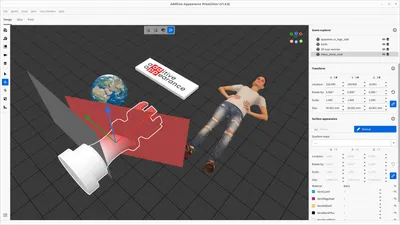
Press release announcing our new slicer software: A Photorealistic, Color-Optimized Upgrade for Multi-Material 3D Printing
A step-by-step guide to generate accurate, photorealistic previews of PolyJet color prints so you can soft‑proof your design before printing.
